PDF Ebook The Microsoft Way: The Real Story Of How The Company Outsmarts Its Competition, by Randall E. Stross
This is not about how much this publication The Microsoft Way: The Real Story Of How The Company Outsmarts Its Competition, By Randall E. Stross prices; it is not also concerning just what kind of publication you really enjoy to review. It is regarding what you can take and also get from reading this The Microsoft Way: The Real Story Of How The Company Outsmarts Its Competition, By Randall E. Stross You could choose to pick other book; however, it does not matter if you try to make this e-book The Microsoft Way: The Real Story Of How The Company Outsmarts Its Competition, By Randall E. Stross as your reading choice. You will not regret it. This soft file book The Microsoft Way: The Real Story Of How The Company Outsmarts Its Competition, By Randall E. Stross can be your good pal all the same.
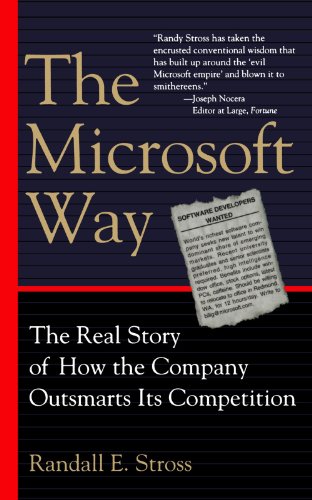
The Microsoft Way: The Real Story Of How The Company Outsmarts Its Competition, by Randall E. Stross

PDF Ebook The Microsoft Way: The Real Story Of How The Company Outsmarts Its Competition, by Randall E. Stross
The Microsoft Way: The Real Story Of How The Company Outsmarts Its Competition, By Randall E. Stross Actually, book is really a home window to the globe. Even many people might not appreciate reading publications; guides will certainly consistently provide the precise details about reality, fiction, encounter, journey, politic, faith, and much more. We are right here a site that offers collections of publications greater than guide establishment. Why? We provide you great deals of numbers of link to obtain the book The Microsoft Way: The Real Story Of How The Company Outsmarts Its Competition, By Randall E. Stross On is as you require this The Microsoft Way: The Real Story Of How The Company Outsmarts Its Competition, By Randall E. Stross You can find this book effortlessly here.
When getting this e-book The Microsoft Way: The Real Story Of How The Company Outsmarts Its Competition, By Randall E. Stross as referral to read, you can get not only motivation however likewise brand-new expertise and lessons. It has greater than common advantages to take. What type of publication that you read it will work for you? So, why need to get this e-book qualified The Microsoft Way: The Real Story Of How The Company Outsmarts Its Competition, By Randall E. Stross in this write-up? As in link download, you can get the publication The Microsoft Way: The Real Story Of How The Company Outsmarts Its Competition, By Randall E. Stross by on-line.
When getting guide The Microsoft Way: The Real Story Of How The Company Outsmarts Its Competition, By Randall E. Stross by online, you can review them anywhere you are. Yeah, also you are in the train, bus, waiting list, or various other locations, online e-book The Microsoft Way: The Real Story Of How The Company Outsmarts Its Competition, By Randall E. Stross could be your buddy. Every single time is a good time to read. It will enhance your knowledge, fun, entertaining, lesson, and also experience without spending even more cash. This is why on-line book The Microsoft Way: The Real Story Of How The Company Outsmarts Its Competition, By Randall E. Stross comes to be most really wanted.
Be the first who are reviewing this The Microsoft Way: The Real Story Of How The Company Outsmarts Its Competition, By Randall E. Stross Based upon some factors, reading this e-book will offer more advantages. Also you require to review it detailed, page by web page, you can complete it whenever as well as any place you have time. When a lot more, this on-line book The Microsoft Way: The Real Story Of How The Company Outsmarts Its Competition, By Randall E. Stross will certainly provide you simple of reviewing time as well as activity. It likewise offers the encounter that is economical to get to as well as acquire considerably for better life.
"An engaging look at Microsoft's success"—The San Francisco Chronicle
- Sales Rank: #2268683 in Books
- Brand: Randall E Stross
- Published on: 1997-08-18
- Original language: English
- Number of items: 1
- Dimensions: 8.00" h x .76" w x 5.00" l, .81 pounds
- Binding: Paperback
- 318 pages
Features
- ISBN13: 9780201327977
- Condition: New
- Notes: BRAND NEW FROM PUBLISHER! 100% Satisfaction Guarantee. Tracking provided on most orders. Buy with Confidence! Millions of books sold!
Amazon.com Review
Stross, an academic business historian, was given unlimited access to interview Microsoft employees and managers and to rifle through most of Microsoft's corporate records. His main conclusion? That Microsoft's phenomenal success is due in large part to its consistent insistence on hiring the smartest people, and that much Microsoft bashing is reflective of an anti-intellectual strain in American culture. Whether you idolize or despise Microsoft, this book is well worth reading--especially if you are in any way responsible for hiring the best and the brightest for your company.
From Publishers Weekly
To critics, Bill Gates's Microsoft Inc. is the apotheosis of brute-force ruthless marketing, but in this lively, independent-minded report, Stross (Steve Jobs and the Next Big Thing) finds a different explanation for Microsoft's success: Gates's strategy of hiring the smartest software developers, keeping their allegiance with lucrative stock options, fostering an egalitarian creative atmosphere and perpetuating the identity of small working groups. A business professor at San Jose State University in California, Stross had unfettered access to Gates, his employees and the company's internal files, making this a privileged, revealing window on Microsoft's inner workings. He charts the firm's long, rocky struggle to win broad consumer acceptance of CD-ROMs, as well as the saga of Microsoft's bestselling multimedia encyclopedia, Encarta. Microsoft was caught unprepared by the advent of the Internet, and its failed attempt to outdo a small but feisty rival, Intuit, in the personal finance software market, demonstrates that Gates is far from infallible, yet Microsoft has swiftly adapted to an Internet-centered software universe, which to Stross signifies a company constantly learning as it grows.
Copyright 1996 Reed Business Information, Inc.
From Library Journal
Business historian Stross follows up his Steve Jobs and the Next Big Thing (LJ 12/93), which was critical of Jobs, with this favorable portrait of Bill Gates and Microsoft's business strategies in the 1990s. Filling a gap in the literature on Microsoft and Gates by focusing on relatively recent Microsoft strategic corporate successes with CD-ROMs, the "Information Superhighway," and overcoming Department of Justice antitrust concerns (which continue, however), Stross's work will nonetheless disappoint both Gates and computing aficionados. Unlike Jobs, Gates and Microsoft top executives cooperated with Stross, who defends his pro-Microsoft tone, claiming nothing else was possible given his findings. Stross discusses only the beginnings of the Netscape-Microsoft browser rivalry, the most serious challenge to Microsoft today. The last section argues interestingly that much of the animosity toward Gates and Microsoft is the result of "our collective reaction to [Gates's wealth]." Despite drawbacks, this is recommended for business collections.?Michael Neubert, Library of Congress, Washington, D.C.--." Despite drawbacks, this is recommended for business collections.?Michael Neubert, Library of Congress, Washington, D.C.
Copyright 1996 Reed Business Information, Inc.
Most helpful customer reviews
3 of 5 people found the following review helpful.
outdated, one-sided, and utterly useless to understand the company
By Robert J. Crawford
It has been a long time since I have some across a book as bad as this one. Not only is the author a kind of apologist for Bill Gates, blithely dismissing Microsoft critics as jealous of a superior being and accusing the FTC of ignorance, but the content is decidedly third rate. First, as a dated piece of work, the author goes over a list of controversies that should interest no one anymore, such as the first proposed information superhighway subscriber schemes. He also goes on and on about Myrvold as a prescient genius nerd, though Gates fired soon after the book was published for incompetence. Second, what the author attempts to cover about how MS works is unbelievably banal, such as hiring the smartest people (instead of those with experience and credentials) or the way that offices are configured. As such, the book was of absolutely no use for question os how MS really does things. Moreover, the edition I got was sloppily printed: a page is missing, there are whole sections in which no periods appear and the like. Finally, the style is boring and hard to follow.
Not recommended. There are far better books on MS available.
10 of 20 people found the following review helpful.
amazingly biased puff piece on Microsoft and Gates
By Winter
Mr Stross' book is very difficult to read by anyone with knowledge of the industry or of Microsoft's products and its business products. Stross manages to skip over many key aspects of Microsoft's rise and its predatory business practices. This includes the omission of Microsoft's deal to supply the official OS for the IBM PC, which provided it with annual profits that were greater than the gross revenues of its competitors. This revenue stream enabled it to repeatedly produce inferior products (spreadsheet, word processing, and OS GUI) for a period of many years, a failure that would have resulted in their closing their doors but for the offsetting profits from their crude DOS operating system. Any refinements to their products were only offered to consumers in response to competitors' superior offerings. Stross even goes so far as to state that Microsoft's practice of charging a license fee for every CPU shipped by computer manufacturers, regardless of whether the user wanted DOS or Microsoft's Windows GUI, benefited the consumer who got a price break (due to volume license discounts) on the operating system they did not want in the first place. If anyone wants to really understand the emergence of Microsoft and the personal computer industry they would do well to look elsewhere.
0 of 0 people found the following review helpful.
Gates pushed for sales volume and profits necessary to increase profits needed to build sophisticated and complex software
By Golden Lion
1. Mike Maples said, “My job is to get a fair share of the software applications market, and to me that’s one hundred percent.” In 1994, Steve Ballmer in his best shouting voice reported increases for Word, Excel, Powerpoint, and Office shouting “its Market share, market share, market share”, “keeping competitors grasping for oxygen”.
2. In 1990, when Microsoft Excel had no chance of stealing market share from Lotus, Gates stated, “if everyone at Lotus went on vacation for a year, we’d still have a hard time competing with 1-2-3 because its momentum would still be there. Once you get to the dominate position, the rewards are incredible.” The potential rewards are commensurate with the challenges of unseating the market leader. Momentum is created from customer loyalty, reputation, promoting and pricing software, by training users, and by navigating the strategic challenges in an industry characterized by high fixed and low marginal costs.
3. In the 1980 Microsoft Excel far outsold Lotus Jazz for the Macintosh. Gates observed, “one the market anoints a leader the entire universe of third-party support - all the books, all the templates, all the training, all the stores stocking - heads in the direction of the leader, too”
4. The software industry lowered the cost of personal computing as the user learned more about the software and it is likely the software will improve; more members join the network; scale of economies in production reduce cost; software helps risk-aversion giving more understanding about complex system and thus adoption is less likely to contain unknown risks; and adoption of a given technology spawns various sub technologies and technical infrastructure that make it increasingly difficult to displace the technology.
5. Nathan Myhrvold predicted software application leaders get 60 to 70 percent of the market and the runner up gets 60-70 percent of the remainder. The market share leader in operating system gets 90 percent of the market and the runner-up gets 90 percent of the remainder. In 1995, Microsoft office had a 90 percent share of the suite segment of the market, exactly what Myhrvold’s earlier remarks had predicted.
6. The consistency of the positive feedback cycle phenomenon suggests that people see considerable benefits in choosing technology that others have also chose. Customers are not force to choose a software. Customer evaluation of the technical, financial, and ancillary benefits of the Software determine the stickiness of the products. Gates would truculently invite critics to name a Microsoft product that’s successful and isn’t a top rated product - “we don’t have one”.
7. Early at Microsoft, Gates reasoned that dramatic improvements in microprocessor would fuel the growth of Microsoft and that of the larger PC industry. The idea that the exponential improving semiconductor technology would create new business opportunities was a prevalent belief. The fact that software developers could not keep pace with the hardware side of business meant plentiful business opportunities for software developers without the imminent fear of oversupply. Gates advocated for commercializing the distribution of software in order to encourage software developers to continue to invest their labor.
8. Gates pushed for sales volume and profits. Only by achieving high volume could software developers overcome the problem of high fixed costs in developing sophisticated products. In 1981, Gates preached, “It’s only through volume that you can offer reasonable software at a low price.”
9. Nathan Myhrvold was born in 1959 and raised by a single parent, his mother. At age two Myhrvold knew he wanted to be a scientist, at 14 graduate from High School, from UCLA at 19 in Batchelors in mathematics and a masters in geophysics and space physics, and Princeton at 23, in mathematical economics and a Phd in theoretical physics. Myhrvold became the de facto helmsman piloting Microsofts technical direction. In 1995, Myhrvold rose to the position of vice president and was a member of Microsoft’s six person office of the president. Myhrvold influential counsel assisted in the direction of strategic planning at Microsoft.
10. At Microsoft, feedback loops went from the marketplace back to the company, from employees to management, and from management back to employees. Gates paid close attention to installing circuits that would serve as conduits of feedback in his own company. For Gates, detailed feedback was an article of faith, and his lieutenants preached feedback with no less fervor. Self-organizing behavior survives on positive feedback in the system. Ballmer said, “if you have a problem you don’t think is getting resolved, well, you are not only allowed to, you are encouraged to talk to your manager’s manager, your manager’s manager’s manager, or whatever it takes to get that opinion heard.”
11. In 1993, a watershed year for Microsoft the company began looking to the future. Microsoft rivals were TCI - cable TV - $4.1 billion, Bell Atlantic ($12.9 billion), Time Warner ($14.5), and AT&T ($67 billion). Myhrvold counsel Gates to think big: Microsoft had cash, the technical expertise, and a vision of new digital possibilities.
12. Microsoft received a $100 million a month in its cash reserves, in retained earnings, each month. Yet it took far longer than a month to negotiate a $100 million deal. Opportunities were presenting themselves and it would take longer to close a $10 million deal than a $100 million deal. If Microsoft limited itself to a handful of giant deals, it would miss smaller companies and other ventures that might add greater yield strategically in the long run. Myhrvold emphasized Microsoft would not be able to single-handedly create an empire on the information highway. Microsoft would have to enter into joint ventures and other partnerships in earnst. Myhrvold understood the peril of jumping into deals as soon as possible. IBM $3.3 billion investment in joint ventures and other external investments during the course of ten years was valued at about $35 million. A lesson on how not to go about expanding a web of technology partners.
13. Microsoft success in transitioning to a network-centered computing structure, entertainment, publishing, telecommunications, consumer electronics, and other converging industries depended on how well the technical elite understood and worked with representatives from industries far removed from personal computing.
14. Siegelman defined MSN as a superset of private and public online services (visa, ecommerce, subscriptions, search engines). The primary competition was the internet itself. Customers could connect with information providers directly without MSN serving as an intermediary. To the extent that Microsoft could successfully persuade users and information providers to adopts it proprietary software for secure transactions on the net, a toll road would be possible. Gates had confidence that a large market would develop and make his propriety software and business come into demand. Gates believed millions of dollars would begin to pour into development. Broadband customers would not switch software that they had become accustom too. Microsoft would compete with the heavy weights in entertainment, communications, and other industries. Gates identified multi-billion-dollar businesses for each broad category of future online services. He assigned shopping and advertising an estimate of $100 billion of annual revenue.
See all 25 customer reviews...
The Microsoft Way: The Real Story Of How The Company Outsmarts Its Competition, by Randall E. Stross PDF
The Microsoft Way: The Real Story Of How The Company Outsmarts Its Competition, by Randall E. Stross EPub
The Microsoft Way: The Real Story Of How The Company Outsmarts Its Competition, by Randall E. Stross Doc
The Microsoft Way: The Real Story Of How The Company Outsmarts Its Competition, by Randall E. Stross iBooks
The Microsoft Way: The Real Story Of How The Company Outsmarts Its Competition, by Randall E. Stross rtf
The Microsoft Way: The Real Story Of How The Company Outsmarts Its Competition, by Randall E. Stross Mobipocket
The Microsoft Way: The Real Story Of How The Company Outsmarts Its Competition, by Randall E. Stross Kindle
The Microsoft Way: The Real Story Of How The Company Outsmarts Its Competition, by Randall E. Stross PDF
The Microsoft Way: The Real Story Of How The Company Outsmarts Its Competition, by Randall E. Stross PDF
The Microsoft Way: The Real Story Of How The Company Outsmarts Its Competition, by Randall E. Stross PDF
The Microsoft Way: The Real Story Of How The Company Outsmarts Its Competition, by Randall E. Stross PDF


